

Identity fraud has become one of the most expensive and disruptive risks facing financial services organizations today. From phishing attacks and credential theft to account takeovers and insider misuse, attackers are no longer trying to “hack systems,” they are targeting people and identities.
At the same time, financial institutions are under relentless regulatory pressure. Compliance frameworks like FINRA, SOX, and GDPR require strict controls around identity verification, access management, data privacy, and auditability. For CIOs and CISOs, this creates a difficult balancing act:
How do you strengthen identity assurance without slowing down operations, increasing friction, or creating new compliance risks?
Microsoft Entra Verified ID is emerging as a powerful answer to this challenge. Built on decentralized identity and verifiable credentials, it helps financial institutions reduce fraud, modernize identity workflows, and remain audit-ready without over-collecting or over-storing sensitive personal data.
This blog explains how Entra Verified ID works, why it matters for financial services, and how it fits into a modern, compliance-driven identity strategy.
Table of Contents
Why Is Identity Fraud a Growing Risk in Financial Services?
For years, financial institutions focused their security investments on network protection, perimeter firewalls, and endpoint defenses. Today, attackers have adapted. Instead of trying to break through technical controls, they exploit the weakest link in most environments: identity.
Stolen credentials, phishing campaigns, social engineering, and insider misuse are now responsible for a majority of security incidents in banking and investment firms. Once an attacker compromises an identity, they often appear as a “legitimate user,” making detection far more difficult.
At the same time, financial organizations face
- – Increased remote and hybrid work
- – Heavy reliance on third-party vendors and contractors
- – Rapid onboarding and offboarding during mergers and acquisitions
- – Growing customer demand for digital, low-friction experiences
Each of these trends expands the identity attack surface. The result is higher fraud risk, greater audit scrutiny, and rising operational costs tied to identity verification and remediation.
Why Are Traditional KYC and IAM Models No Longer Enough?
Traditional identity approaches in financial services rely on a combination of:
- – One-time KYC checks during onboarding
- – Username/password authentication
- – Multi-factor authentication (MFA)
- – Periodic access reviews
While these controls are still important, they were not designed for today’s threat landscape.
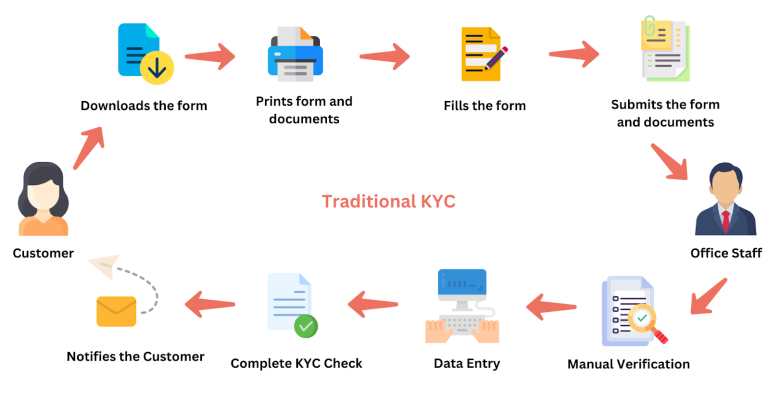
The limitations are becoming clear
- – KYC is often performed once and rarely revisited
- – Sensitive identity documents are copied, stored, and resubmitted repeatedly
- – Passwords and MFA can still be phished or bypassed
- – Identity verification is disconnected from access enforcement
- – Compliance teams struggle to prove “who accessed what and why” during audits
This creates a dangerous gap between identity verification and identity usage. Financial institutions need a way to continuously trust identities, not just authenticate them.
What Is Microsoft Entra Verified ID in Simple Terms?
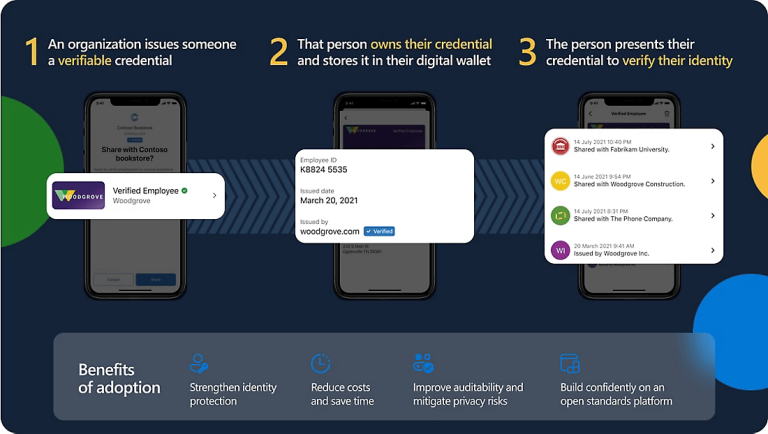
Microsoft Entra Verified ID is a decentralized identity service that allows organizations to issue and verify cryptographically secure digital credentials, also known as verifiable credentials.
Instead of relying on static documents or shared secrets, Verified ID enables trust through proof.
At a high level, the model includes three roles:
- Issuer – The organization that issues a trusted credential
- Holder – The individual who receives and stores the credential
- Verifier – The system or organization that requests proof
Credentials are stored securely in a digital wallet (such as Microsoft Authenticator) and presented only when needed. Importantly, users control what information they share.
For financial institutions, this means identity can be
- – Verified once at a high assurance level
- – Reused securely across systems and workflows
- – Presented without exposing unnecessary personal data
How Does Entra Verified ID Help Reduce Identity Fraud?
At its core, Entra Verified ID reduces fraud by removing the reliance on easily compromised secrets.
Instead of passwords, scanned documents, or screenshots, Verified ID uses cryptographic proofs that are:
- – Tamper-resistant
- – Phishing-resistant
- – Verifiable in real time
Because credentials are digitally signed and validated, attackers cannot easily fake or replay them. Even if an attacker gains access to a system, they cannot impersonate a user without the actual verified credentials.
Additional fraud-reduction benefits include
- – Strong binding between the individual and their identity
- – Reduced the exposure of identity data during verification
- – Clear separation between identity proofing and authentication
- – Support for Zero Trust “verify explicitly” principles
For financial services, this directly reduces risks tied to account takeover, impersonation, and unauthorized access to high-risk systems.
Can Verified ID Reduce Repeated KYC and Manual Identity Checks?
One of the biggest operational challenges in financial services is repeated KYC.
Customers, employees, and contractors are often asked to submit the same documents multiple times across different systems and processes. This increases:
- – Onboarding delays
- – Operational costs
- – Data privacy risk
- – Customer and employee frustration
Entra Verified ID changes this model.
Once an identity has been verified at a high assurance level, a reusable digital credential can be issued. That credential can then be presented whenever identity proof is required without repeating the entire verification process.
This approach
- – Reduces manual document handling
- – Minimizes sensitive data storage
- – Speeds up onboarding and access requests
- – Simplifies audit preparation
For compliance teams, it also creates a clearer chain of trust, making it easier to demonstrate how identities were verified and used.
How Does Government ID Proofing Improve Identity Assurance?
In regulated financial environments, not all identities carry the same level of risk. Some roles and transactions require strong identity proofing.
Microsoft Entra Verified ID supports this through integration with certified identity verification (IDV) partners. These partners validate:
- – Government-issued IDs (such as passports or driver’s licenses)
- – Biometric checks like selfie or liveness verification
- – Document authenticity and integrity
This process aligns with standards such as NIST SP 800-63, which define Identity Assurance Levels (IALs).
Once proofing is completed
- – A high-assurance credential is issued
- – The credential can be reused without repeating verification
- – Access decisions can be tied to the assurance level of the identity
For financial institutions, this supports regulatory expectations while maintaining operational efficiency.
How Does Entra Verified ID Integrate with the Microsoft Security Stack?
Verified ID does not replace Microsoft Entra ID; it strengthens it.
Together, they create a layered identity security model:
- – Entra Verified ID provides identity assurance
- – Entra ID manages authentication and access
- – Conditional Access enforces policies based on risk
- – Microsoft Sentinel provides monitoring and audit visibility
For example:
- – A verified credential can be required for high-risk access
- – Conditional Access can evaluate identity assurance before granting access
- – Sentinel can log and correlate identity-based activity for investigations
This integration ensures identity trust is not isolated but embedded across the security lifecycle.
How Can Financial Institutions Stay Audit-Ready with Verified ID?
Audit readiness is not just about passing audits, it’s about confidence.
Entra Verified ID supports audit readiness by:
- – Creating verifiable proof of identity assurance
- – Reducing reliance on static documents
- – Supporting privacy-by-design principles
- – Providing traceable identity workflows
From a compliance perspective, this helps organizations align with:
- – FINRA expectations around access control and accountability
- – SOX requirements for internal controls
- – GDPR principles of data minimization and purpose limitation
Instead of collecting more data, financial institutions can prove trust with less.
How Does Simplicity IT Help Financial Institutions Implement Verified ID?
Implementing Verified ID is not just a technical exercise; it requires alignment with compliance, security, and business operations.
Simplicity IT helps financial institutions by:
- – Assessing identity risk and regulatory requirements
- – Designing Verified ID architectures aligned with compliance frameworks
- – Integrating with Entra ID, Conditional Access, and Sentinel
- – Implementing government ID proofing workflows
- – Supporting audits, reporting, and ongoing optimization
The goal is not just deployment, but measurable risk reduction and compliance confidence.
Key Takeaways
- – Identity fraud is one of the biggest risks facing financial services today
- – Traditional KYC and IAM models are no longer sufficient
- – Microsoft Entra Verified ID enables high-assurance, privacy-first identity
- – Verifiable credentials reduce fraud and simplify compliance
- – With the right strategy and partner, financial institutions can modernize identity without disrupting operations
Frequently Asked Questions (FAQs)
What is Microsoft Entra Verified ID, and why is it important for financial services?
Microsoft Entra Verified ID is a decentralized identity service that allows organizations to issue and verify cryptographically secure digital credentials. For financial services, it helps establish strong identity assurance, reduce fraud, and improve compliance by replacing fragile, document-based identity verification with verifiable digital proof.
How does Entra Verified ID reduce identity fraud in banks and financial institutions?
Entra Verified ID reduces identity fraud by eliminating reliance on passwords, screenshots, and static documents. Instead, it uses digitally signed credentials that are resistant to phishing, impersonation, and replay attacks. This makes it significantly harder for attackers to misuse stolen identities.
Is Entra Verified ID a replacement for traditional KYC processes?
No. Entra Verified ID does not replace KYC; it modernizes how KYC outcomes are used. Once identity verification is completed, a verifiable credential can be issued and reused securely, reducing the need for repeated document checks while maintaining strong compliance controls.
How does Entra Verified ID support regulatory compliance like FINRA, SOX, and GDPR?
Entra Verified ID supports compliance by improving identity assurance, reducing unnecessary data collection, and creating auditable identity workflows. It aligns with privacy-by-design principles and helps organizations demonstrate who accessed systems, when, and under what level of identity assurance.
Can Entra Verified ID be used for both employees and external users?
Yes. Entra Verified ID can be used for employees, contractors, vendors, partners, and even customers. This makes it particularly valuable for financial institutions that work with external parties or manage temporary access during audits, projects, or M&A activities.
How does government ID proofing work with Entra Verified ID?
Government ID proofing is enabled through Microsoft-certified identity verification partners. These partners validate government-issued IDs and perform biometric checks, such as selfie or liveness verification. Once completed, a high-assurance credential is issued through Entra Verified ID.
Does Entra Verified ID integrate with Microsoft Entra ID and Conditional Access?
Yes. Entra Verified ID integrates seamlessly with Microsoft Entra ID and Conditional Access. Organizations can require verified credentials for high-risk access scenarios and enforce identity-driven policies as part of a Zero Trust security model.
How does Entra Verified ID improve audit readiness?
Entra Verified ID improves audit readiness by creating verifiable evidence of identity assurance and access decisions. Instead of relying on screenshots or manual documentation, organizations can demonstrate cryptographic proof of identity verification and access controls during audits.
Is Entra Verified ID suitable for highly regulated financial environments?
Yes. Entra Verified ID is designed for regulated environments where strong identity assurance, privacy protection, and auditability are critical. It supports high-assurance identity proofing and integrates with enterprise security and compliance tools used in financial services.
Does using Entra Verified ID increase user friction?
No. In many cases, Entra Verified ID reduces friction. Users verify their identity once and then reuse their credentials securely, eliminating repeated document uploads and manual verification steps while maintaining strong security.





WG777login? That’s where it’s at! Made the login easy peasy. Take a gander wg777login
wg777, is totally worth checking out, my dude. Good stuff there. Investigate wg777
Alright, 777xk, alright! Tried it out on a whim and now I’m hooked. Quick payouts and a decent selection of games. Give it a shot! 777xk
CAKFRCTQWKSmpZrXoDTaHkSw
DcuxIIYulIjQJnzI